
For a brief period between 2022 and the end of 2025, California families had a powerful tool to hold negligent parties accountable. Under a temporary law known as SB 447, the estates of deceased victims could recover “non-economic damages”—specifically, the physical pain, mental suffering, and emotional distress the victim endured before they passed away. However, as we move into the second quarter of 2026, that window has officially closed.
As of January 1, 2026, California has reverted to its long-standing traditional rule. This shift has massive implications for current and future litigation, particularly in cases involving catastrophic injuries or toxic torts where the victim passes away before a verdict is reached.
The Sunset of SB 447: What Happened in 2026?
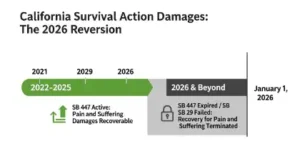 In 2021, the California Legislature enacted SB 447 as a “pilot program.” It amended California Code of Civil Procedure Section 377.34 to allow for the recovery of a decedent’s pain and suffering. The goal was to prevent insurance companies from intentionally delaying trials in hopes that an elderly or ill plaintiff would die, thereby wiping out the most significant portion of the claim’s value.
Despite efforts to extend this law via SB 29, the bill stalled in the 2025 legislative session and was not reenacted. This means that for any survival action filed on or after January 1, 2026, these non-economic damages are once again prohibited. California has returned to being part of a small minority of states that do not allow a victim’s estate to collect for the human suffering endured before death.
Survival Action vs. Wrongful Death: The 2026 Distinction
It is vital for grieving families to understand that while survival actions have changed, wrongful death claims remain a separate and powerful path to justice. Here is the distinction under current 2026 law:
- Wrongful Death (CCP 377.60): These claims belong to the heirs (spouse, children, etc.). They compensate the family for their losses, such as loss of financial support, funeral expenses, and the loss of the decedent’s companionship and guidance.
- Survival Action (CCP 377.34): These claims belong to the estate. They seek to recover what the victim could have sued for if they had lived. As of 2026, this is now limited primarily to economic damages: medical bills incurred before death, lost wages, and property damage.
The Impact on Settlement Values
The expiration of the SB 447 expansion means that the “valuation” of a case changes significantly if a plaintiff dies. During the pilot period, a survival action for a victim who suffered for months with a terminal illness could be worth millions in non-economic damages. Today, if the action is filed after the 2026 cutoff, that same case might be limited to the cost of the medical bills.
This “reversion” of the law makes it more important than ever to work with a California personal injury attorney who can strategically navigate these timelines. If your loved one was injured, filing the claim as soon as possible is the only way to ensure all avenues of recovery are explored before a potential death changes the legal landscape.
Is There Any Way to Still Recover These Damages?
There are very few exceptions to the new 2026 rule, but they are critical to investigate:
- Cases Filed Before 2026: If the survival action was filed on or before December 31, 2025, the right to pain and suffering damages is “vested” and preserved, even if the case goes to trial in 2026 or 2027.
- Trial Preference: Cases that were granted “trial preference” (typically due to a plaintiff being over 70 or in failing health) before certain dates may still qualify under specific legacy provisions of the code.
- Punitive Damages: Punitive damages—meant to punish particularly egregious or “malicious” conduct—are still recoverable in survival actions, even after the 2026 sunset.
To understand which category your case falls into, you should review our guide on wrongful death claims in California to see how to maximize the recovery for the family’s personal loss.
Preparing for the Future: Will the Law Change Again?
 The legal community in California is currently divided. While defense attorneys and insurance groups celebrated the sunset of SB 447 as a return to “fairness,” consumer advocates are already drafting new versions of SB 29 for the next legislative cycle. They argue that the 2026 reversion creates a “death discount” for negligent corporations.
Until a new law is passed, however, we must operate under the current statutes. If you are dealing with a serious injury or the loss of a loved one, you need to act quickly to preserve evidence. See our checklist on collecting evidence after a crash to ensure your case is built on a solid foundation from day one.
Conclusion: Seeking Justice in a Changing Legal Climate
The “sunset” of California’s expanded survival damages is a reminder of how quickly the law can change. While the loss of pain and suffering recovery in these actions is a blow to many estates, there are still multiple ways to hold a wrongdoer accountable and secure the financial future of your family.
At Accidents Attorney, we specialize in adapting to these legislative shifts. We are committed to finding every possible path to compensation for our clients, even when the laws become more restrictive.