
As automotive technology advances, features like automated braking, lane-keeping assistance, adaptive cruise control, and full self-driving modes have transitioned from sci-fi concepts into everyday reality. Millions of vehicles on the road today utilize Advanced Driver Assistance Systems (ADAS) or test semi-autonomous capabilities. However, when an automated feature fails, misinterprets road markings, or fails to stop for an obstacle, a complicated legal question emerges: Who pays for damages in an autonomous vehicle crash?
Understanding autonomous vehicle accident liability requires stepping outside traditional driver-versus-driver personal injury claims. In crashes involving artificial intelligence or assisted driving software, liability often shifts between human driver negligence and corporate product liability. Determining who is legally at fault depends on the level of automation engaged at the exact moment of impact.
The Spectrum of Autonomy: Human Responsibilities vs. Machine Control
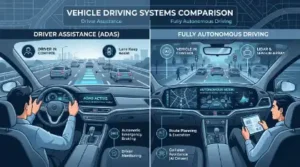
To determine who is financially responsible after a crash, safety regulators and courts look to the Society of Automotive Engineers (SAE) levels of driving automation. The key distinction lies in who is tasked with monitoring the driving environment.
Level 0 to Level 2: Partial Automation (Human Monitoring Required)
Most commercial vehicles marketed today with feature names like “Autopilot,” “ProPILOT,” or “Super Cruise” fall under Level 2 partial automation. Under these systems, the vehicle can control steering and acceleration simultaneously, but the human driver is required to keep their hands on the wheel, monitor the road continuously, and take immediate control if a hazard appears.
In Level 2 crashes, insurance companies and courts typically hold the human operator negligent if they were distracted, hands-free when forbidden, or failed to override the system before an impending impact.
Level 3 to Level 5: High to Full Automation (System Monitoring)
In Level 3 (conditional) to Level 5 (full driverless) systems—such as commercial robotaxis—the automated driving system (ADS) performs the complete dynamic driving task. When a true driverless vehicle causes a crash due to sensor blind spots, algorithm errors, or mechanical failure, primary liability typically transitions away from human occupants and onto the vehicle manufacturer or fleet operator under product liability law.
Key Parties Who May Be Held Liable in an ADAS Collision
Because autonomous crashes involve both software algorithms and hardware components, injury claims frequently name multiple defendants. Potentially liable parties include:
- The Human Operator: Liable if they over-relied on an assistant feature, were sleeping or texting, or ignored system takeover warnings.
- Auto Manufacturers: Subject to strict product liability claims if the vehicle suffered from a design defect, manufacturing flaw, or a failure to adequately warn consumers about system limitations.
- Third-Party Software Developers: Responsible if corrupted over-the-air (OTA) software updates or faulty object-detection algorithms caused improper vehicle behavior.
- Hardware Component Suppliers: Liable if defective hardware—such as cameras, radar units, or LiDAR sensors—failed to accurately scan surrounding traffic.
- Maintenance Contractors: Third-party shops or service hubs that failed to properly calibrate delicate vehicle sensors following prior body repairs.
The Critical Role of Telematics and “Black Box” Data
Unlike standard rear-end collisions where physical skid marks tell much of the story, proving fault in an autonomous crash relies heavily on digital telemetry. Modern ADAS-equipped vehicles record extensive real-time operational data.
When investigating a self-driving collision, personal injury attorneys and accident reconstruction experts issue formal spoliation letters to preserve key telemetry sources, including:
- Event Data Recorder (EDR) Files: Logs recording vehicle speed, steering angle, brake application, and seatbelt status seconds prior to impact.
- System Status Logs: Timestamps proving whether autopilot or ADAS modes were active, as well as any driver takeover alerts issued by the onboard computer.
- Driver Monitoring Camera Video: Cabin camera footage evaluating whether the driver had their eyes on the road or hands on the steering wheel.
- External Camera & Sensor Feeds: Sensor recording files showing how the vehicle’s computer classified external obstacles, pedestrians, or adjacent traffic.
To review federal safety reporting mandates for automated driving systems and real-world collision statistics, consult official incident reporting data provided by the National Highway Traffic Safety Administration (NHTSA).
Steps to Take Following a Crash Involving an Autonomous Vehicle
If you are involved in a collision with a semi-autonomous car or a fully driverless vehicle, taking specific legal preservation steps early is essential:
- Report the Incident to Police: Ensure officers record that an automated driving feature was engaged or that the vehicle operated without a human driver.
- Document On-Dash Displays & Cameras: Photograph dashboard alert screens, camera lenses, and sensor arrays mounted around the exterior of both vehicles.
- Identify the Vehicle Make & Version: Take note of specific trim badges (e.g., Full Self-Driving, Super Cruise) and the software release version if accessible.
- Obtain Medical Evaluation: Visit an emergency room or physician immediately to document physical injuries, creating a clear medical record linking your condition to the crash.
- Retain Specialized Legal Representation: Partner with a personal injury law firm capable of subpoenaing manufacturer server data before automated cloud logs are overwritten.
Navigating Complex AI Injury Claims

As self-driving technology evolves, insurance policies and tort laws continue to adapt. Recovering full financial compensation after an autonomous vehicle accident requires bridging the gap between standard driver negligence and complex corporate product liability. Securing electronic evidence early ensures that responsible auto manufacturers, software engineers, or negligent drivers are held accountable for your medical bills, lost earnings, and long-term recovery costs.