
For decades, personal injury claims followed a predictable path. When two cars collided on a California roadway, proving fault meant identifying human negligence—whether it was a driver speeding, running a red light, or texting behind the wheel. Today, that framework is fundamentally changing. The massive commercial deployment of Level 3 and Level 4 autonomous vehicles (AVs), alongside highly advanced consumer automated driver-assistance systems (ADAS), has forever altered the anatomy of a crash claim.
The Multi-Party Ecosystem: Who Shares Fault in an AI Crash?
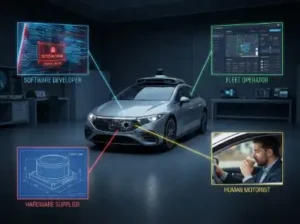
In an ordinary accident, an injured party works with a car accident lawyer to file a claim against a single driver’s third-party liability insurance policy. In contrast, an autonomous vehicle collision strips away individual simplicity, spreading liability across multiple corporate entities simultaneously. Under current 2026 strict product liability and algorithmic negligence doctrines, an investigation typically targets four primary parties:
- The Original Equipment Manufacturer (OEM): The automaker can be held strictly liable under a design or manufacturing defect framework if the vehicle’s structural layout or integrated system components fail to safely execute normal driving behaviors.
- The Software & AI Developers: Autonomous vehicles rely on complex machine learning algorithms to make split-second driving choices. If the programming experiences an “edge case” classification failure—such as failing to differentiate a white tractor-trailer from a brightly lit sky—the software developer may face direct liability.
- Hardware Sensor Suppliers: Autonomous operation is impossible without real-time data feeding from LiDAR, radar, cameras, and ultrasonic nodes. If a third-party supplier manufactures a sensor that is overly susceptible to blind spots, severe weather interference, or lens fogging, it falls under product liability law.
- The Fleet Operator or Rideshare Platform: Tech corporations deploying massive fleets of robotaxis are legally responsible for operating them safely. If a fleet operator deploys a vehicle in hazardous weather outside its safe operational domain, or ignores an unpatched technical vulnerability, they are directly negligent.
The Danger of Over-the-Air (OTA) Software Updates
One of the most complex vectors in modern autonomous vehicle litigation involves the tracking of over-the-air (OTA) software updates. Modern vehicles are essentially software-defined machines. Automakers regularly push silent background updates directly to consumer cars to modify braking parameters, adjusting lane-keep sensitivities, or tweaking object-recognition protocols.
While these updates are meant to improve vehicle safety, they can inadvertently introduce software bugs, latency lags, or algorithmic conflicts that cause unpredictable vehicle behaviors. A vehicle that operated perfectly on Monday could experience a sudden “phantom braking” failure on Tuesday due to a corrupted code deployment overnight.
When an accident occurs immediately following an OTA update, the manufacturer or software developer can be exposed to extensive product liability claims. For your legal team, proving this requires a swift, technical audit of the vehicle’s version history at the exact millisecond of the impact. If a corporate entity pushed unvalidated or poorly tested code into the public driving space, they may be guilty of algorithmic negligence.
When a vehicle controlled by an algorithmic driving matrix or a suite of optical sensors causes a collision, who is to blame? The answer is rarely a single negligent motorist. Instead, modern litigation involves a web of corporate interests, product engineers, and technical fleet operators who must answer to the safety enforcement rules set by the National Highway Traffic Safety Administration (NHTSA).
Sensor Failures and the “Black Box” Battle for Evidence
When an autonomous vehicle experiences a mechanical or digital failure, the resulting data is a critical piece of evidence. Every self-driving platform utilizes an internal Data Storage System for Automated Driving (DSSAD) and an Event Data Recorder (EDR)—effectively a vehicle “black box”. This equipment continuously records telemetry streams, sensor inputs, object detection logs, and human handover request histories.
In a standard collision, defense insurers may attempt to blame road conditions or human error. However, an autonomous vehicle accident attorney can subpoena these digital logs to show exactly what the vehicle’s AI system saw—or failed to see—prior to the impact. For example, the logs can definitively prove if a forward-facing camera accurately detected a pedestrian but the braking system suffered a fatal processing delay, confirming a clear product liability lawsuit scenario.
A Critical Warning on Evidence: Tech platforms and autonomous vehicle manufacturers hold tight control over cloud servers and internal vehicle data logs. If an injured victim delays legal action, this volatile telematics data can be completely overwritten or erased during subsequent fleet maintenance cycles, permanently destroying the proof needed to back your claim.
The Illusion of the Attentive Driver: Level 3 Autonomy Handover Pitfalls
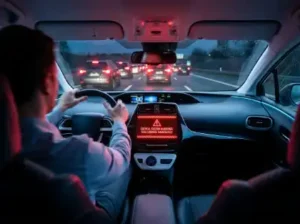
Many modern consumer vehicles use Level 3 conditional automation. Under this tier, the computer completely controls the dynamic driving tasks within specific environments, but expects the human occupant to step in immediately if the system issues a “takeover request”.
This creates a dangerous legal gray area. If the vehicle’s software encounters a complex construction zone and abruptly hands control back to an unprepared human occupant with only a two-second warning window, a severe accident is highly likely. In these scenarios, car manufacturers often try to blame the driver for failing to stay attentive.
However, aggressive legal discovery often reveals that the vehicle’s human-machine interface (HMI) design was inherently flawed, creating an unreasonable expectation for human response times. If the design itself failed to provide safe, clear, and timely transition cues, the manufacturer remains legally exposed for the resulting injuries.
How an Autonomous Vehicle Accident Attorney Secures Justice
Because autonomous vehicle claims involve highly funded automotive giants and massive tech companies, standard personal injury approaches fall short. Fighting corporate defense teams requires building an airtight evidentiary foundation using advanced engineering assessments, digital forensics, and accident reconstruction professionals.
If you or someone you love has been injured in a collision involving a self-driving vehicle, or a car utilizing autonomous driver assistance, you cannot afford to wait. Ensuring your medical treatments are documented, issuing immediate data preservation demands to the vehicle’s corporate owner, and navigating the evolving 2026 legal landscape is the only reliable way to hold multi-billion-dollar tech giants accountable for their technical failures.