
As of 2026, electric bicycles are no longer just a niche hobby—they are a primary mode of transportation across California. From the busy streets of San Francisco to the suburbs of Butte County, e-bikes have transformed how we commute. However, with higher speeds and heavier frames than traditional bicycles, e-bike accidents have reached record highs. In response, California has enacted sweeping new legislation in 2026 that fundamentally changes how victims seek compensation after a crash or a battery-related injury.
Whether you were hit by a car while riding or injured by a malfunctioning electrical system, the new standards under Assembly Bill 544 (AB 544) and Senate Bill 1271 (SB 1271) provide powerful new tools for your legal recovery. Understanding these changes is critical to protecting your rights in a personal injury claim.
The 24/7 Visibility Rule: A New Shift in Comparative Fault
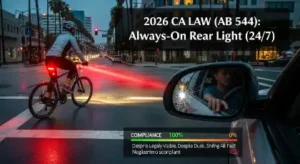 One of the most significant changes for 2026 is the “Always-On” visibility requirement. Under AB 544, effective January 1, 2026, every electric bicycle in California must be equipped with a rear red reflector or a red rear light (solid or flashing) that is visible from 500 feet at all times—not just at night.
For personal injury cases, this is a critical detail. In the past, insurance companies would often blame riders for “low visibility” during dawn, dusk, or foggy conditions. Under the new 2026 standards, visibility is no longer a nighttime-only obligation. If a driver hits an e-bike that wasn’t equipped with these mandatory lights, the defense will almost certainly argue for comparative negligence. Conversely, if you were compliant, it significantly strengthens your claim that the driver was 100% at fault for failing to see a legally equipped rider in broad daylight.
Product Liability: Suing for E-Bike Battery Fires
2026 marks a turning point for e-bike battery safety. Senate Bill 1271 now mandates that all new e-bikes, batteries, and charging systems sold or leased in California must be tested and certified by accredited laboratories to meet specific standards, such as UL 2849 (for the full electrical system) or UL 2271 (for the battery pack).
This creates a massive opportunity for victims of “thermal runaway” or battery fires. If you purchased an e-bike in 2026 that lacked this certification and it caused property damage or physical injury, you may have a direct Product Liability claim against:
- The Manufacturer: For failing to meet state-mandated safety certifications.
- The Retailer: For selling or leasing an uncertified, illegal unit in the state of California.
- The Battery Producer: For defective lithium-ion cells that lead to catastrophic failure.
The “Fake E-Bike” Crackdown: Motor Vehicle Reclassification
California is also tightening the enforcement of the three-class system. As of 2026, retailers must clearly label the classification, top speed, and motor power at the point of sale. Many “e-bikes” on the road today have been illegally modified to exceed 28 mph, essentially turning them into unregistered motorcycles.
In 2026, if a rider is found to be operating a modified “out-of-class” bike, they may lose certain protections under standard bicycle accident laws. They could be held to the stricter standards of motor vehicle operators, requiring registration and insurance. Furthermore, modifying a bike to exceed its class limits can be used as evidence of negligence in the event of a crash.
Age Restrictions and Safety Courses for Minors
Protecting young riders is a primary focus of the 2026 updates. While the 16-year-old age limit for Class 3 e-bikes remains in place, new provisions allow minors who receive helmet violations to complete a CHP-developed online safety and training program as an alternative to paying a fine. However, from a liability perspective, if a parent allows a child to ride an “out-of-class” or modified e-bike, that parent may face significant legal exposure under parental liability statutes if an accident occurs.
Expert Tip: If you are hit by a commercial vehicle while on an e-bike, always check for “smart” rig sensors. As we see in AI-assisted trucking accidents, the data from those vehicles can often prove the driver failed to see a legally lit cyclist.
How We Prove Your E-Bike Claim in 2026
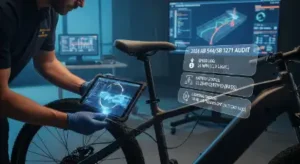
Proving liability in an e-bike case now requires a technical, data-driven approach. At accidentsattorney.net, our investigation process for 2026 claims includes:
- Digital Controller Audits: We verify the bike’s speed settings to prove it was operating within legal class limits at the time of the crash.
- Certification Verification: We check the battery and charger for permanent UL labels to confirm (or rule out) illegal equipment as a cause of injury.
- Visibility Mapping: We use forensic recreation to prove the rider was visible to the striking vehicle under the new 24/7 mandate.
Whether you are dealing with a rideshare collision or a complex product failure, the legal landscape of 2026 is intricate. You need a team that stays ahead of these legislative shifts to ensure insurance companies don’t use new regulations to devalue your claim.