
For over a decade, California’s “Move Over” law was a specific shield intended to protect those who protect us: police officers, firefighters, paramedics, and tow truck drivers. However, as of January 1, 2026, the legal landscape of the Golden State has shifted toward a more universal standard of roadside safety. With the full implementation of Assembly Bill 390 (AB 390), the “Move Over” requirement now extends to every single motorist stopped on the side of the road.
This isn’t just a change in traffic etiquette; it is a fundamental shift in how liability is determined in roadside collisions. If you were struck while standing by your disabled vehicle, or if you were involved in a collision because another driver failed to yield space, the 2026 expansion of the California Move Over Law is now the most critical piece of evidence in your personal injury claim.
What is AB 390? The 2026 Expansion Explained
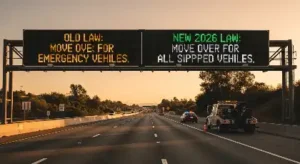
Prior to 2026, California Vehicle Code § 21809 required drivers to move over or slow down only when approaching an authorized emergency vehicle, tow truck, or marked Department of Transportation vehicle displaying flashing amber or red lights. While effective, this left a “safety gap” for civilian motorists—the family changing a flat tire, the student waiting for a jumpstart, or the gig worker checking a GPS map.
The 2026 amendment changes the language of the law to include any stationary vehicle displaying hazard warning lights. Whether it is a luxury sedan, a beat-up pickup truck, or a delivery van, if the hazards are blinking, the approaching traffic has a legal mandate to move over. This law was passed in response to rising “secondary accident” statistics, where drivers hitting a stationary vehicle cause more fatalities than the original breakdown itself.
The “Negligence Per Se” Factor: A Game Changer for Victims
In a standard car accident case, the victim (plaintiff) must prove that the other driver was “negligent”—meaning they failed to act with reasonable care. This often leads to “he-said, she-said” arguments about speed, distraction, and visibility.
However, the 2026 expansion introduces the doctrine of Negligence Per Se. Under California law, if a defendant violates a statute (like the Move Over Law) and that violation causes the exact type of injury the law was meant to prevent, the defendant is presumed to be negligent.
How this helps your case:
- Shifted Burden: You no longer have to prove the driver was “careless.” You only have to prove they violated AB 390 by not moving over when your hazards were on.
- Faster Settlements: Insurance companies are much more likely to offer a fair settlement when they know a statutory violation makes a trial defense nearly impossible.
- Clear Liability: Even if you were partially “in the way,” the law now places the primary burden of safety on the moving vehicle to avoid the stationary one.
Understanding the Two Mandates: “Move Over” vs. “Slow Down”
The 2026 California Move Over Law provides two options for drivers, depending on road conditions. Understanding these is vital for your accidents attorney when reconstructing the crash scene.
1. The Move Over Mandate
On highways with two or more lanes in the same direction, a driver must move out of the lane immediately adjacent to the stationary vehicle, provided it is safe and legal to do so. Failure to merge left (if you are on the right shoulder) is a direct violation of the law.
2. The Slow Down Mandate
If traffic is too heavy to merge, or if the road only has one lane in that direction, the driver must slow down to a speed that is “safe and prudent.” In 2026, many legal experts define this as at least 20 mph below the posted speed limit. If a driver zips past your disabled vehicle at 70 mph in a 65 mph zone, they have breached their duty of care under AB 390.
Special Considerations for Truck and Motorcycle Accidents
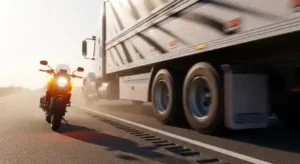
The impact of this law varies depending on the types of vehicles involved. In truck accidents, the “Move Over” law is especially pertinent. Semi-trucks require more time and space to merge. If a commercial driver sees a vehicle with hazards a half-mile ahead and fails to begin their merge, their negligence is amplified due to the professional standards required of CDL holders.
Conversely, in motorcycle accidents, the victim is often the one stopped. A motorcyclist on the shoulder is highly vulnerable to “wind blast” from passing cars. The 2026 law recognizes this vulnerability, requiring cars to give the full lane of space to even the smallest stationary vehicles.
Common Insurance Company Defenses (And How We Fight Them)
Even with the 2026 law in place, insurance adjusters will try to devalue your claim. Common tactics include:
- “The Hazards Weren’t On”: They may claim you didn’t have your warning lights active. We counter this by pulling vehicle ECU data or checking dashcam footage.
- “It Wasn’t Safe to Move Over”: They may argue traffic was too thick. We use traffic flow data and highway cameras to prove whether a merge was possible.
- “Comparative Fault”: They might argue you parked too close to the white line. Under the new law, the driver’s failure to slow down often outweighs minor parking issues.
Steps to Take After a Roadside Accident in 2026
If you are struck while stopped on a California road, your actions in the first ten minutes can determine the success of your future legal claim:
- Leave the Hazards On: Do not turn them off until the police arrive and document them in the report.
- Take Photos of Vehicle Positioning: Show the distance between the passing lanes and your vehicle.
- Identify Witnesses: Did another driver stop? Their testimony that “it was easy to move over, but the defendant didn’t” is gold for your case.
- Seek Medical Attention: Roadside impacts often cause “soft tissue” injuries or whiplash that don’t appear for 24-48 hours.
Conclusion: Your Rights Under the 2026 California Move Over Law
The expansion of the Move Over Law is a victory for road safety and for the rights of accident victims. It simplifies the path to justice by creating a clear, statutory standard of care that every driver must follow. If a driver ignored your hazard lights and caused you harm, they must be held accountable.
At Accidents Attorney, we specialize in the intersection of new technology, new laws, and old-fashioned aggressive representation. We understand the nuances of AB 390 and how to use it to secure the maximum compensation for your medical bills, lost wages, and pain and respiratory suffering.